China Top 10 Wall Mounted Display Rack Suppliers
China’s wall-mounted display rack industry serves retailers, pharmacies, showrooms, and trade spaces worldwide. A well-chosen rack can turn a bare wall into useful selling space. But appearance alone is not enough. Buyers also need to assess materials, load capacity, finish quality, mounting hardware, customization options, and production consistency. Small details matter: a rough weld, uneven powder coating, or unclear installation guide can complicate a project.
Retail expert Paco Underhill is often quoted as saying, “The more time a customer spends in a store, the more likely they are to buy.” Thoughtful product presentation can help shape that experience. Wall-Mounted Display Racks may support clearer browsing, better use of floor space, and more flexible merchandising, provided the design suits the products and the wall itself. Not every rack fits every store. That sounds obvious, yet it is easy to overlook.
This guide introduces ten China-based suppliers for buyers comparing product ranges and manufacturing capabilities. It considers practical questions such as available rack styles, material choices, order flexibility, quality-control practices, and communication during production. These points can help narrow a shortlist, but they do not replace direct checks. Ask for current specifications, finish samples, and clear load information before ordering. A supplier’s catalog may look polished; the details still deserve scrutiny. No ranking can settle every buyer’s needs. The best choice depends on the merchandise, installation conditions, budget, and the reliability you can verify yourself.
What Wall-Mounted Display Racks Are and Where They Are Used
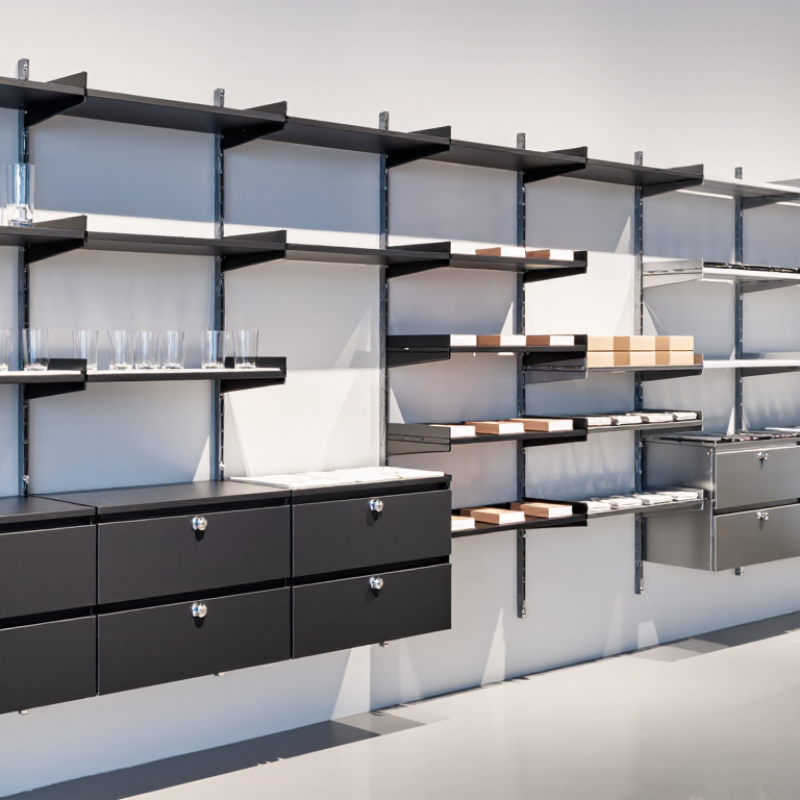
A wall-mounted display rack is a fixture secured to a wall to present products, tools, or information. Unlike freestanding shelving, it leaves the floor clear and can make a narrow shop or hallway easier to navigate.
Designs range from simple shelves and slat panels to hooked rails and clear-front holders. The right format depends on what it must carry. Small packaged goods need a different layout from folded clothing or heavy hand tools.
These racks appear in retail stores, libraries, workshops, reception areas, and homes. A shop may place accessories near a checkout, while a workshop can keep frequently used tools visible and within reach. Libraries use wall displays to feature books without filling another aisle.
Small details matter: shelf depth, viewing height, edge protection, and spacing between items affect how easily people can browse. Check the rack’s rated capacity and match its fixings to the wall material; when the wall structure is uncertain, ask a qualified installer.
A tidy display can still feel cramped. I have seen well-arranged products become hard to reach when a rack sits too high or projects into a walkway. Placement deserves a second look.
How China’s Wall-Mounted Display Rack Market Is Organized
China’s wall-mounted display rack market is organized less like a single industry and more like a chain of specialized workshops, component makers, and export-oriented suppliers. Some factories cut and bend steel in-house; others source brackets, hooks, and back panels from nearby producers, then assemble finished systems. The distinction matters. It can affect lead time, customization, and who resolves a dimensional error.
Suppliers also differ by capability. Metal fabricators make wire grids, slatwall supports, and powder-coated shelves, while retail-fixture specialists may provide layout drawings and sample builds. Trading companies can coordinate several processes, which helps with mixed orders, but buyers should confirm who manages production and inspection. Request a drawing that shows hole spacing, shelf depth, and stated load capacity. A rack that looks sturdy in a photograph may flex under boxed goods.
The market serves both standard and custom demand. Standard sizes suit quick replenishment; custom runs can match a store’s wall width, though revisions may add time. Finish samples help: a coated-steel coupon reveals texture and color shifts better than a screen. I would not treat a low quote as proof of efficiency. It may reflect thinner material, simpler packaging, or accepted variation. Clear tolerances can prevent an awkward conversation later.
Criteria for Evaluating Chinese Display Rack Suppliers
When comparing Chinese wall-mounted display rack suppliers, look beyond product photos. Ask for drawings with dimensions, material thickness, bracket spacing, and stated load capacity. Confirm whether the rating applies to each shelf or the complete rack. Wall type matters too: a rack tested on concrete may need different fixings on hollow brick or drywall. Request installation guidance for your actual wall.
Check how the supplier controls quality. Ask about incoming material checks, weld inspection, coating thickness, and carton drop testing. A production sample can reveal sharp edges, uneven paint, or holes that do not align. Review the inspection record, not just a polished catalogue. Also compare production lead time, packaging details, spare-part availability, and who handles defects. A low quote is less useful if replacement parts take weeks. I would still verify critical measurements independently; paperwork can be correct while a sample is not.
Tips: Send the same specification sheet to each supplier. Include a simple sketch, target load, finish, quantity, and delivery date. Ask each supplier to confirm any assumptions in writing. Small gaps in a drawing often become costly changes later.
Profiles of 10 Leading Wall-Mounted Display Rack Suppliers
This guide profiles ten types of wall-mounted display rack suppliers, focusing on practical strengths rather than unsupported rankings. Supplier 1 specializes in steel racks for hardware shops, with adjustable arms for changing product sizes. Supplier 2 builds timber displays for bakeries and home-goods retailers, where finish and shelf depth matter. Supplier 3 offers modular systems that staff can rearrange with basic tools. Supplier 4 focuses on compact racks for narrow store aisles. Supplier 5 produces wire displays that keep packaged goods visible and easy to reach.
Supplier 6 works with custom dimensions, useful when a wall has pipes or uneven surfaces. Supplier 7 supplies lightweight racks for temporary retail layouts. Supplier 8 emphasizes heavier-duty construction for tools or boxed stock. Supplier 9 provides coordinated shelves, hooks, and signage rails. Supplier 10 handles larger production runs for multi-location retailers. These are distinct capabilities, not guarantees of quality. Ask for load ratings, material specifications, installation guidance, and sample photos before comparing quotes.
A reliable supplier should explain how its rack is mounted and what wall types it supports. Look closely at welds, coated edges, fasteners, and shelf spacing. A rack may look sturdy in a photo and still feel awkward in daily use. That detail is easy to miss. Discuss packaging and replacement parts too, especially for larger orders. The comparison is not perfect: local installation conditions can change the best choice. Store staff feedback after a trial installation can reveal problems a catalogue cannot.
How to Compare Suppliers and Plan a Purchase
When comparing China-based wall mounted display rack suppliers, request the same drawing and load specification from each. Compare steel thickness, bracket spacing, finish, weld quality, packaging, sample lead time, and the stated load limit. Ask whether that limit applies to one shelf or the complete rack. Look beyond price. A low quote can omit anchors, protective packaging, or installation hardware.
The World Steel Association’s World Steel in Figures 2024 reports 1,892.2 million tonnes of crude steel production in 2023. That scale makes a steel description alone weak evidence of rack quality; ask for material specifications and inspection records. UNCTAD’s Review of Maritime Transport 2024 says seaborne trade grew 2.4% in 2023 and projected 2.7% growth for 2024, a reminder to confirm shipping assumptions directly with suppliers. For a purchase plan, approve a physical sample, verify carton dimensions, and agree on inspection criteria before production. Check whether quoted lead times include packing and port delivery. One easy-to-miss detail: wall type affects anchor choice, so confirm the intended installation surface before ordering. Some plans still overlook this. Keep a written record of revisions, approved finishes, and acceptable tolerances; vague confirmations can cause costly rework.
China Top 10 Wall Mounted Display Rack Suppliers — How to Compare Suppliers and Plan a Purchase
Compare the approximate densities of common display-rack materials when assessing wall load and shipping weight. Values are typical reference figures; actual density varies by material grade and product construction.
Ask suppliers to specify the material grade, finished-product weight, mounting method, and tested load capacity. Material density alone does not determine rack strength or safe wall loading.